
Sustainable souvenirs, and how to tell the real ones from the marketing
The sustainable souvenir aisle is where the gift trade's vocabulary goes to die. Eco-friendly. Earth-conscious. Green. Responsibly sourced. Words with no definition, no audit, and no consequence for being wrong.
That is a problem for a buyer, because the customer asking about it is often your most engaged customer, and getting caught repeating a supplier's unverifiable claim is worse than never making one.
So here is the practical version: four questions that separate a real sustainability story from a printed adjective, and what a small shop can actually check.
Question one: what specifically happens, and who does it?
"Supports the environment" is not a claim, it is a mood.
A real claim has a mechanism you can describe in a sentence to a customer. Money goes to a named organisation. A specific material replaced a specific worse material. A measurable quantity of something gets removed, planted, or funded per unit sold.
If a supplier cannot tell you what physically happens, nothing physically happens.
What you can check: ask for the name of the recipient organisation and the amount per unit. A supplier doing real work answers immediately because they are proud of it. A supplier doing marketing changes the subject to their values.
Question two: is the packaging the product's biggest problem?
For most souvenirs, the object is not the environmental issue. The polybag, the hang tag, the shipper, and the carrier bag are.
A shirt made from organic cotton, sealed in a plastic bag, inside a plastic mailer, handed over in a plastic carrier is not a sustainable product. It is a sustainable fibre wearing three layers of the problem.
This is the question most "eco" merchandise fails, and it is the easiest one for a buyer to assess, because you can see the packaging before you order.
What you can check: ask what it arrives in. You will get a straight answer, and it tells you more than any certification logo.
Question three: does it survive being owned?
The most sustainable souvenir is the one that does not get thrown away.
Durability is a sustainability property and it is almost never discussed as one, because it is not certifiable and cannot be printed on a swing tag. A cheap tee that pills after four washes has a worse footprint than a heavier one that lasts a decade, no matter what either is made of.
The same is true of packaging. A container people keep has effectively zero disposal cost, and it keeps the shop that sold it visible on a shelf for years.
What you can check: handle the sample. Weight, stitching, whether the print is likely to crack. You already know how to do this; you just may not have filed it under sustainability.
Question four: can the customer verify it themselves?
This is the strongest test and almost nothing passes it.
Most sustainability claims are unfalsifiable by design. The customer is asked to take the brand's word, the shop's word, and a logo on faith. That asymmetry is exactly why people have stopped believing any of it.
A claim the buyer can check personally is a different kind of claim. Not a logo, not a paragraph on a website, but something they do themselves and see the result of.
What you can check: whether there is anything for the customer to do. If the entire sustainability story happens invisibly and offstage, it is a story.
What this rules out, and what it leaves
Run the four questions across a typical eco display and most of it thins out fast. Bamboo versions of plastic things, recycled-content items with no accounting, anything whose claim lives entirely in an adjective.
What survives tends to be boring and concrete: items with a named recipient and a per-unit amount, packaging that is genuinely part of the product rather than waste around it, goods built to outlast the trip, and anything the customer can confirm without trusting you.
That last category is nearly empty in the souvenir trade, which is why it is the most defensible place to be.
Where the trade-offs actually are
Anyone claiming a product is purely good is selling something. The honest position is that every option trades one problem for another, and knowing which trade you made is the difference between a defensible claim and a slogan.
Local making versus material. A product made fifty miles away from a conventional material may beat an organic one shipped from another continent, or it may not. It depends on weight, mode of transport, and how the fibre was grown, and almost nobody has those numbers.
Durable versus recyclable. These pull against each other more often than the category admits. The thing built to last a decade is frequently harder to recycle at the end. A single material that survives ten years usually wins over a compostable one that survives a season, but it is a judgement, not a rule.
Reusable packaging versus less packaging. A container people keep has a bigger upfront footprint than no container at all, and earns it back only if they genuinely keep it. If it ends up in a bin, the minimal option was better.
None of this is a reason to stop asking. It is a reason to prefer suppliers who can talk about the trade-offs, because the ones who cannot have not thought about it.
How the can answers the four
Being direct about our own product, since it would be strange to write this and not.
What happens: every activated can funds $0.50 toward a cause the buyer chooses. Ocean and river plastic cleanup, tree planting, food support, school funding, bee protection, or seagrass planting. Reference amounts are roughly one pound of plastic removed, or three trees, or five meals, depending on what gets selected.
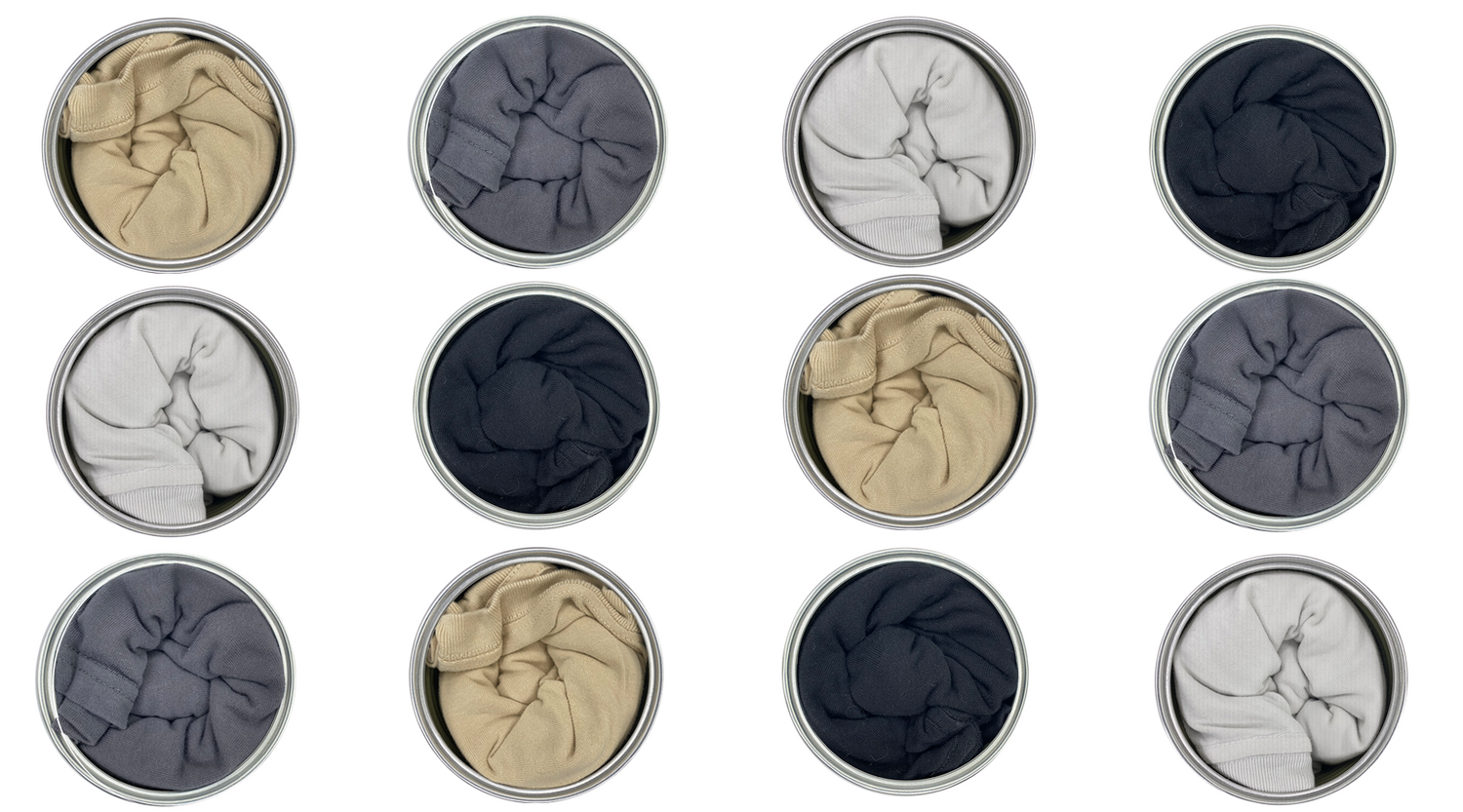
The packaging: the can is the packaging and the customer keeps it. Aluminium, recyclable indefinitely, and rigid enough that people use them as pen cups and plant pots rather than binning them. There is no polybag.
Durability: a 210 GSM garment dyed cotton tee, which is a weight people buy on purpose rather than a giveaway blank.
Customer verification: this is the part that matters. The card inside carries a code. The buyer scans it at cannedgoods.love, picks the cause themselves, and sees the choice land. They are not taking anyone's word for it, which is the only version of this that holds up.
Each can also contains plantable flower seeds and a sticker.
The red flags, plainly
Things that reliably signal marketing rather than substance, gathered from the category's own copy.
An adjective with no noun. "Eco-friendly materials" without naming the material. "Sustainably made" without naming what changed.
A percentage with no denominator. "30% recycled content" of what, by weight or by volume, of which component.
A logo that is not a certification. A green leaf in a circle is a graphic. GOTS, Fairtrade and FSC are audited schemes with registries you can search. Most of what appears on souvenir packaging is the former dressed as the latter.
Offsetting presented as reduction. Carbon neutral shipping is a payment, not a change in what happened. It can be legitimate and it is not the same claim as using less.
A donation with no recipient. "A portion of proceeds" is not a number and "supports conservation" is not an organisation.
None of these prove bad faith. All of them mean you cannot repeat the claim to a customer without risk, which for a shop is the same problem.
What customers actually ask
Worth knowing, because it is narrower than the marketing assumes.
They rarely ask about supply chains. What they ask, at the counter, is some version of "does this actually do anything" and they are asking whether they are being sold a feeling. A staff member who can answer in one concrete sentence closes that; a staff member who reaches for the brand's adjectives does not.
That is the real argument for stocking things that pass the four questions. Not ethics as a marketing position, but that your team can answer the question without guessing.
For a buyer deciding what to stock
You do not need a sustainability section. Sectioning it signals that the rest of the shop is the other thing.
What works better is one or two items that pass all four questions, stocked in the normal run of the shop, that you can explain in a sentence when asked. One defensible product beats a shelf of adjectives, and it is considerably easier to sell.
More on the format in what a shirt in a can actually is, and on picking stock that clears in best selling souvenirs. The custom process is on the custom cans page.