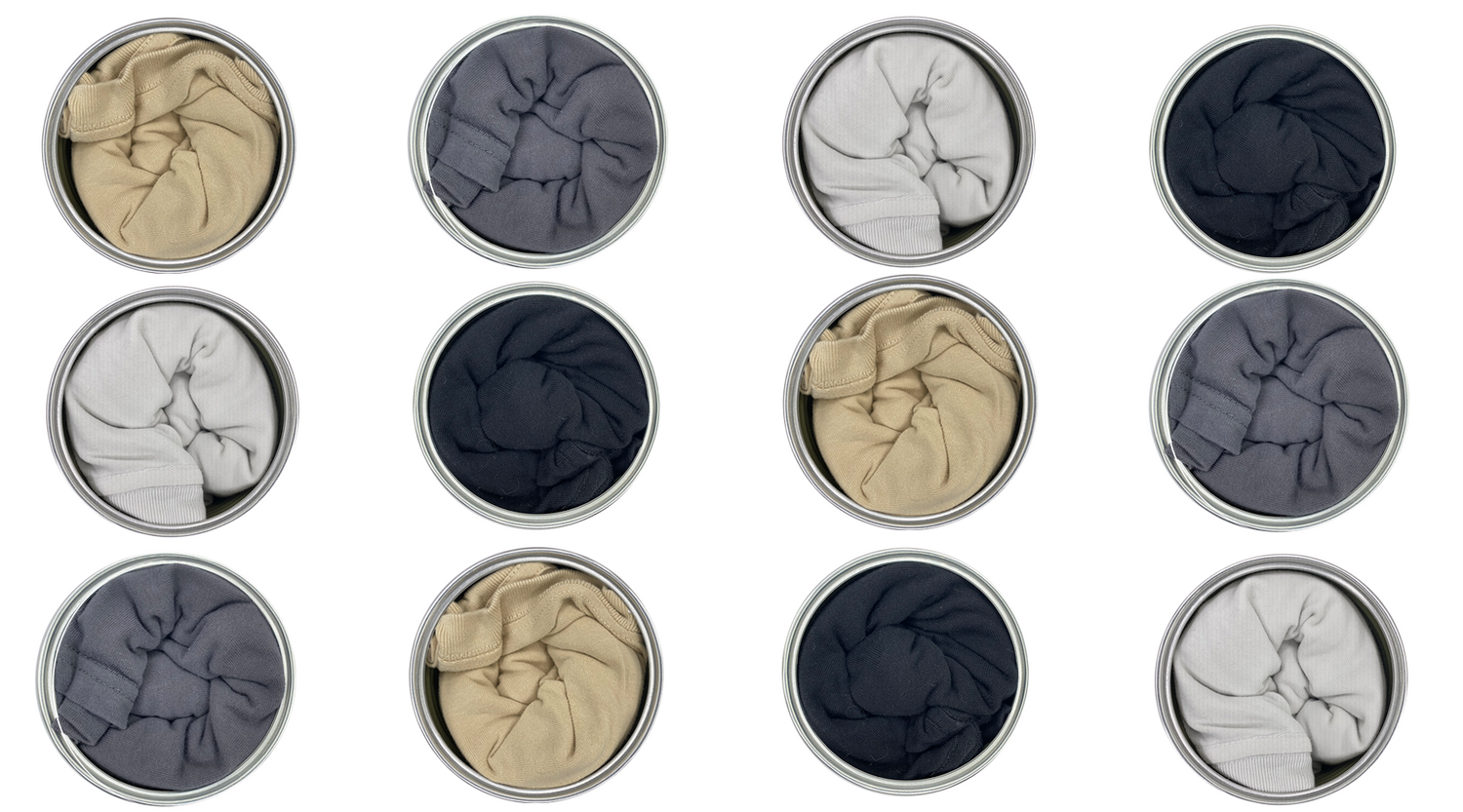

What is a shirt in a can?
A shirt in a can is exactly what it sounds like. A full size cotton t-shirt, folded and sealed inside an aluminium can with a pull tab lid, wrapped in a printed label. You pop the top, the shirt comes out, and you are left holding a can that most people do not throw away.
That last part is the whole point, and it is the part most descriptions miss.
What is actually inside one
The can is 4 inches wide and 4.8 inches tall. Roughly the size of a short beer can, which is the comparison everyone reaches for and the reason the object reads instantly.
Inside ours:
- A 210 GSM garment dyed t-shirt, 100% cotton. That is a heavier weight than a standard promotional tee, closer to what people buy on purpose than what they are handed at an event.
- A sheet of plantable seed paper embedded with wildflower seeds.
- A sticker.
- An impact card with a scannable code.
The shirt is folded, not compressed. That distinction matters more than it sounds and it has its own article, because there is a separate product category built on machine pressed shirts and the two get confused constantly.
Why a can instead of a bag
Most apparel arrives in a polybag that goes in the bin within about four seconds of opening.
An aluminium can does three things a polybag cannot.
It survives. Aluminium is infinitely recyclable, and more relevantly it is rigid, so it sits on a desk or a windowsill instead of collapsing into rubbish. People keep them. That was not a designed outcome at first, it is just what customers started doing, and it has since become the reason the format works.
It photographs. The opening is an event. There is a tab, a hiss, a reveal. That is a thing people film, which is why a single one of our reels reached 8.3 million views and why the account has passed 100 million total views across Instagram and TikTok. A folded shirt on a shelf does not do that. A can does.
It carries a brand at full wrap. The label is a 360 degree printable surface. For a business putting its logo on something, that is considerably more real estate than a hang tag.
What the impact card does
Every can carries a card with a code. Scanning it at cannedgoods.love lets the person who opened the can choose where 50 cents goes.
The options are ocean and river plastic cleanup, tree planting, food support, school funding, bee protection, and seagrass planting. Fifty cents is not an abstraction at that scale, it is roughly one pound of plastic removed, or three trees, or five meals, or a school day, depending on what gets picked.
We are specific about this because the sustainable merchandise category is thick with claims nobody can check. A code the customer scans themselves, on a page that shows them the choice, is a different kind of claim. It is the one part of the product a buyer can verify without taking our word for anything.
Who actually buys these
Two groups, and they want different things from the same object.
People buying one. Usually as a souvenir or a gift, often because they saw it and had not seen anything like it. The can is the reason. A t-shirt with a place name on it is a category that has existed forever and generates no reaction at all. The same shirt in a can gets photographed.
Businesses buying several hundred. Gift shops, breweries, resorts, tour operators, museums. They are not buying t-shirts. They are buying the only thing in their store that nobody else on the street has, in a category where every shop sells the same magnets, keychains and postcards.
A donut shop in Sedona, Arizona sold over 6,000 custom cans in a single year. Sedona Golf Resort carries them. Jacks Surfboards carries them across more than five retail locations. Those are not pilot programmes, they are a product doing volume in ordinary retail.
How the custom version works
A business gets its own can. Its own artwork, its own label, its own shirt design, and nobody else has that design.
That exclusivity is not a nice extra, it is the mechanism. A souvenir that is available everywhere is a commodity and gets priced like one. A can that exists in exactly one shop is a reason to go into that shop. Every account we work with rejected the option of putting new text on existing artwork, which told us something early: the customisation is not decoration on the product, it is the product.
Design is handled in house. Details on quantities and the process live on the custom cans page.
What happens to the can afterwards
This is the question we get most and the answer is genuinely open.
People use them as pen cups, coin jars, plant pots for the seed paper that came inside, and shelf objects. A meaningful number just line them up. The cans are designed with that in mind, which is why the artwork wraps the full body rather than sitting on one face.
There is a second order effect that matters if you sell them. A shirt goes in a drawer. A can stays visible. Whatever business is printed on it keeps being seen for as long as it sits there, which is not something a hang tag or a paper bag ever does.
The questions people ask before buying one
Does the shirt come out creased? It is folded, not pressed, so it comes out the way a shirt comes out of a drawer. Pressed shirts are a different product and they do need a wear or a wash to relax.
What sizes fit in a can? The full standard adult range. The can size is fixed at 4 by 4.8 inches and the fold accommodates the range, which is the practical reason the format works for apparel and would not work for a hoodie. We get asked about hoodies regularly and the honest answer is that the can required would be large enough to break the whole idea.
Can you open it without a tool? Yes. It is a pull tab, the same as a drinks can. No opener, no scissors.
Is the can recyclable? Aluminium, and recyclable indefinitely without quality loss, which is unusual among packaging materials. Most people keep them instead, which is arguably the better environmental outcome anyway.
What is the seed paper for? It is embedded with wildflower seeds. Plant it, water it, and it grows. Several customers plant it directly in the empty can, which was not the plan but is now the most common thing people post.
Why a business picks this over other custom merchandise
A shop deciding between this and a custom printed tee, a tote, or a branded drinkware run is really deciding between two different things.
The other options are all versions of the same product: your logo on a blank that anyone can buy. They are fine, they are cheap, and every business in town has access to identical blanks. Whatever gets printed, the object underneath is the same object.
The can is not a blank with a logo on it. The artwork wraps the whole thing, the design is exclusive to that account, and the object itself is the reason a customer picks it up. That is a different competitive position, and it is why the businesses stocking these tend to treat the can as the hero item rather than as another line on the merchandise order.
Is this the same thing as those pressed shirts?
No, and it is worth being precise because the search results mix them together.
There is an established promotional product where a shirt is machine pressed into a puck and dropped in a tin, made to be handed out free at trade shows. Same silhouette, completely different object, completely different price and purpose.
Ours is a retail product. Someone pays full price for it because they want it. The full comparison is here.
The short version
A shirt in a can is a heavyweight cotton tee, folded into a recyclable aluminium can, packed with seed paper, a sticker, and a card that funds something. It is bought by people who want a souvenir worth keeping and by shops that want the one item on the street nobody can copy.
You can see the current range on the canned tees collection, or search "shirt in a can" on Instagram and watch a few hundred people open one.