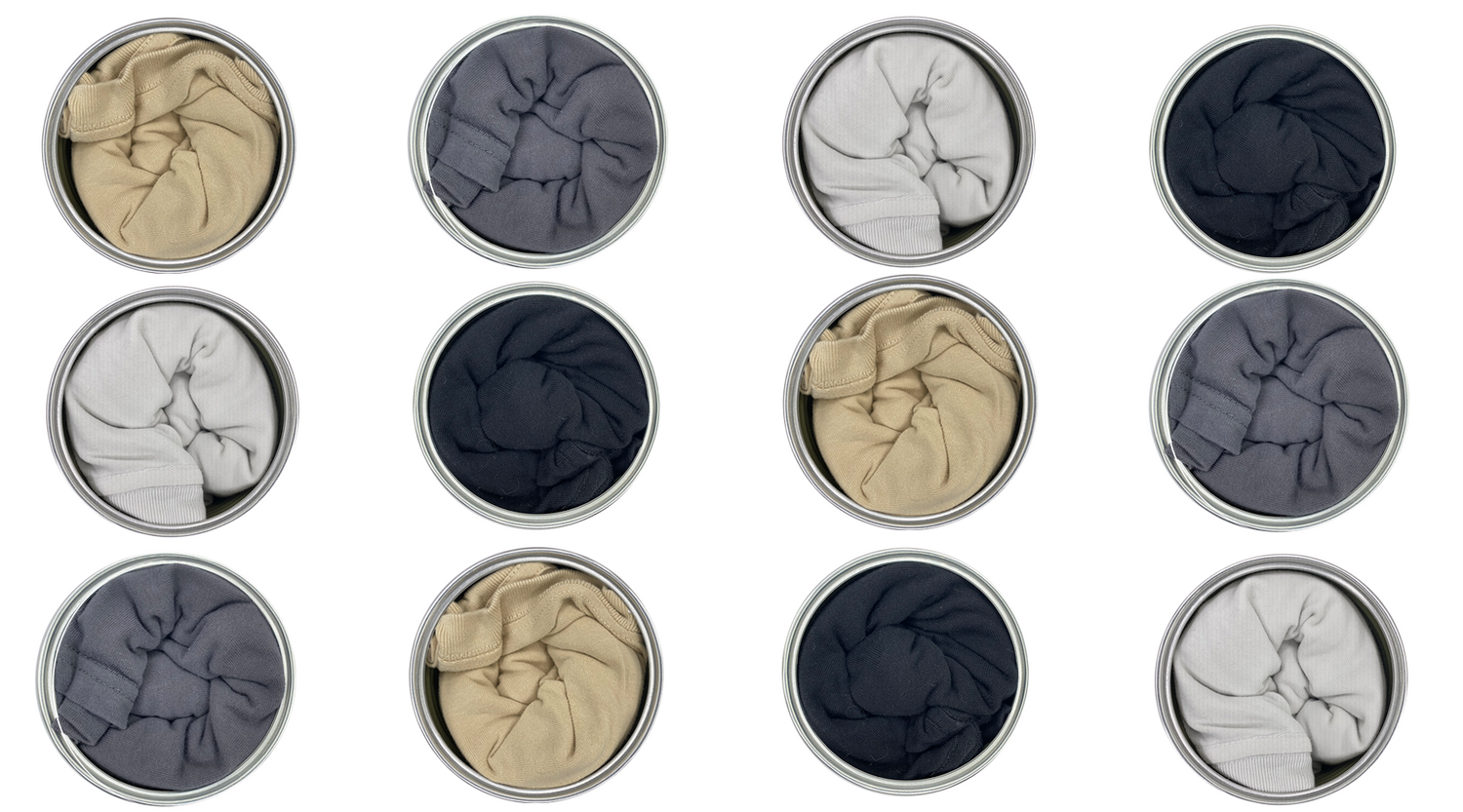

Compressed t-shirt in a can vs. a retail shirt in a can
Search for a shirt sealed inside a can and you will get two products mixed together in the same results. They look similar in a photo. They are not the same thing, they are not bought by the same people, and confusing them will cost you either money or a season of dead stock, depending on which mistake you make.
Here is the actual difference.
The compressed version
A compressed t-shirt in a can is a shirt that has been machine pressed into a dense puck and dropped into a tin. The compression is the engineering: it lets a full size garment fit into a container far smaller than the garment.
It exists to be given away. Trade show booths, conference bags, race packets, staff onboarding kits. The economics are built around volume and low unit cost, the tins are usually stock shapes with a printed label, and the shirt inside is typically a lightweight blank because the shirt is not the point of the exercise. The point is that a prospect walks away holding something with your logo on it.
There is a whole supply chain for this. Companies offer stock shapes by the hundred, custom moulds if you order enough, and the entire category is priced against other promotional giveaways.
If what you need is 500 branded items to hand out free at an event, this is a genuinely good product and you should buy it. Nothing below is an argument against it.
The retail version
A retail shirt in a can is a different proposition. The shirt is folded rather than pressed, the can is a full aluminium beverage can with a pull tab, and the object is built to be sold at full price to a customer who chose it.
Ours is a 210 GSM garment dyed cotton tee in a can measuring 4 inches by 4.8 inches, with plantable seed paper, a sticker, and a card that funds a cause the buyer selects. It sits on a shelf in a shop next to other things a customer could buy instead, and it has to win that comparison on its own.
That single difference, given away versus chosen, drives everything else about how the two products are built.
Why compression changes the product
Pressing a shirt into a puck is not a neutral packaging decision.
It constrains the garment. Heavier fabrics compress poorly and recover badly. The weight range that presses well is the lighter end, which is why compressed tees skew towards thin blanks. A 210 GSM garment dyed tee is not a good candidate for a press.
It creates a garment that has to recover. A pressed shirt comes out with set creases and needs a wash or a wear to relax. Acceptable in a conference bag. Not acceptable in something someone paid full retail for and wants to wear that evening.
It optimises for volume, not for the object. The tin is a container. Nobody keeps it, because there is no reason to.
The folded approach gives up the size advantage and gets a wearable garment and a container worth keeping in return. Which trade is correct depends entirely on whether the recipient paid.
The tin and the can are not the same object either
This gets overlooked and it is the part that decides whether anyone keeps the packaging.
A promotional tin is a container with a label. A beverage can is a recognisable cultural object with a tab, a seal, and a specific sound when it opens. That familiarity is why the reveal registers as an event rather than an unwrapping.
It is also why people film it. One video of a customer opening one of ours reached 8.3 million views, and the account has passed 100 million total views across Instagram and TikTok. That number is not a claim about the shirt. It is a description of what happens when the packaging is interesting enough that a stranger points a phone at it.
The second consequence is durability of the impression. A tin from a trade show is in a drawer or a bin within a week. A can with good artwork ends up on a desk holding pens, or on a shelf, or planted with the seed paper that came inside it. Whatever brand is printed on it keeps being seen.
Which one you actually want
The decision is not about the product. It is about who pays.
Choose the compressed version if you are giving them away, the unit cost has to be low because you are buying in the thousands, the recipient did not ask for it, and the goal is logo exposure rather than a transaction. It does that job well.
Choose the retail version if it is going on a shelf with a price on it, the customer has to actively want it over the alternatives, and you need it to hold up as an object rather than as a handout. A souvenir that feels like conference swag will not sell at souvenir prices, and a customer can tell the difference immediately.
The failure mode worth avoiding is buying the giveaway product for a retail shelf. It looks like the right thing in a photograph and it will not move, because a customer standing in a shop is comparing it to everything else they could spend that money on, and a thin pressed tee in a stock tin loses that comparison.
How to think about the two budgets
The two products come out of different budgets and get judged by different tests, which is the cleanest way to tell which one a situation calls for.
A compressed tee comes out of a marketing budget. It is a cost of attending the event, measured against other things you could hand someone: a tote, a bottle, a notebook. Success is that a prospect leaves holding your name. Nobody expects the item to return money directly, so the only sensible optimisation is unit cost.
A retail can comes out of an inventory budget. It is bought to be sold, and it is measured against every other thing that could occupy the same shelf. Success is sell-through and whether customers ask for it again. That reframes cost entirely: what matters is not what a unit costs but whether units move, because unsold stock at any price is the expensive outcome.
This is why comparing the two on unit cost produces the wrong answer every time. They are not competing for the same money and they are not being asked to do the same job.
The mistake that actually happens
The common failure is a shop that finds the promotional product first, because that is what the search results surface, orders it for a retail shelf, and concludes the format does not work.
The format worked fine. The product was built to be free. A customer standing in a gift shop with money in their hand is running a comparison, and a thin pressed blank in a stock tin loses that comparison to almost anything with a story attached. The shop then has a season of dead stock and a reasonable but wrong belief that shirts in cans do not sell.
If you are evaluating the category, make sure you know which of the two you are looking at before you draw a conclusion from it.
What retail performance looks like
For a sense of the numbers on the retail side: a donut shop in Sedona, Arizona sold over 6,000 custom cans in a single year. Sedona Golf Resort carries them. Jacks Surfboards stocks them across more than five locations. Each of those businesses has its own artwork, and no other business has that design.
That exclusivity does not exist in the promotional category, where the same stock shapes are available to anyone who orders them. In retail it is the entire argument, because a souvenir that is available in every shop on the street is a commodity and gets treated as one.
The short version
They share a silhouette and nothing else. One is a pressed blank in a stock tin, designed to be handed to someone free, and it is good at that. The other is a folded heavyweight tee in a printed aluminium can, designed to be picked up, paid for, and kept afterwards.
If you are stocking a shop rather than filling conference bags, you want the second one. More detail on the format is in what a shirt in a can actually is, how it fits a merchandise mix is in best selling gift shop items, and the custom process is on the custom cans page.