
Eco friendly gift shop products that survive a customer asking questions
A customer picks something up and asks whether it's actually any good for the environment, or whether that's just printed on it.
That's the whole problem with eco friendly gift shop products, and it happens at the counter, to whoever's working that shift, with a queue behind them. If the honest answer is a shrug, you've lost the sale and a bit of trust with it.
So this isn't a list of green products. It's about which ones your staff can defend in one sentence.
Why most of the category doesn't survive the question
Walk a trade show and you'll collect a hundred products described as eco-friendly, earth-conscious, sustainably made, or responsibly sourced. None of those words have definitions. None are audited. Nobody is penalised for being wrong.
That's not always cynicism. Plenty of suppliers genuinely believe their own copy and have simply never been asked a hard question about it. But from where you're standing it doesn't matter, because you're the one who has to repeat it to a customer.
The useful filter is simple: can you say what physically happens, in one sentence, without using an adjective?
"It's made from recycled ocean plastic collected in Indonesia" is a sentence. "It's eco-friendly" is a mood.
The four questions to ask a supplier
I ask these about our own product too, and they're uncomfortable in a useful way.
What specifically happens, and who does it?
A real claim names a mechanism. A material replaced another material. Money goes to a named organisation. A measurable quantity gets removed or planted per unit sold.
If a supplier can't tell you what physically occurs, nothing physically occurs.
What does it arrive in?
For most gift shop stock, the product isn't the environmental problem. The polybag, the hang tag, the shipper and the carrier bag are.
An organic cotton item sealed in plastic, inside a plastic mailer, handed over in a plastic bag is not a sustainable product. It's a sustainable fibre wearing three layers of the thing you were trying to avoid.
This is the easiest question for you to check, because you'll see the answer when the box arrives.
Will it survive being owned?
Durability is a sustainability property and almost nobody discusses it as one, because you can't certify it or print it on a tag.
A cheap tee that pills after four washes has a worse footprint than a heavy one that lasts a decade, regardless of what either is made from. Same for packaging: a container people keep has effectively no disposal cost.
You already know how to assess this. Pick up the sample. Check the weight, the stitching, whether the print will crack. You just may not have filed that under sustainability before.
Can the customer check it themselves?
This is the strongest test and hardly anything passes it.
Most claims are unfalsifiable by design. The customer is asked to trust the brand, the shop, and a logo. That asymmetry is exactly why people stopped believing any of it, and they're right to have stopped.
A claim someone can verify personally is a different category of claim.
The price question, honestly
Sustainable stock usually costs more wholesale, and the standard advice is to pass that on because customers will pay a premium for green products.
In my experience that's only half true, and the half that's wrong loses shops money.
People will pay more for something they want that also happens to be defensible. They will not pay more for something mediocre because it's defensible. Sustainability is a tiebreaker, not a reason. If the item only has the green story going for it, the premium won't hold and you'll be marking it down in October.
The version that works is to buy things that would earn their shelf on merit, and treat the sustainability as the thing that closes a wavering customer rather than the thing that opens them.
What tends to survive
Local makers. Short supply chain, verifiable provenance, and money that stays in the town your visitors came to see. You can name the person who made it, which beats any certification for the counter conversation.
Consumables with real packaging. Honey, soap, coffee, candles in reusable containers. They get used up, which sidesteps the whole durability question, and the packaging is often the best part.
Things built to last decades. Enamel, stainless, cast iron, heavy cotton. Boring, unfashionable, and the actual answer more often than the clever material is.
Products with a named recipient and a per-unit amount. Not "a portion of proceeds". A number, and an organisation you can look up.
Anything with a second life designed in. Packaging that becomes a thing. Seeds you plant. A container people keep on a shelf rather than binning.
What to be careful with
Bamboo versions of plastic things. Sometimes genuinely better, often processed heavily with chemicals nobody mentions, and shipped a very long way. Ask the four questions rather than assuming the material settles it.
Recycled content with no denominator. "30% recycled" of what, by weight or volume, in which component.
Offsetting presented as reduction. Carbon neutral shipping is a payment, not a change in what happened. It can be legitimate. It isn't the same claim.
Logos that aren't certifications. A green leaf in a circle is a graphic. GOTS, Fairtrade and FSC are audited schemes with searchable registries. Most of what appears on souvenir packaging is the first thing dressed as the second.
The trade-offs nobody mentions
Anyone telling you a product is purely good is selling something. Every option trades one problem for another, and knowing which trade you made is what separates a defensible claim from a slogan.
Local making versus material: something made fifty miles away from a conventional material may beat an organic one shipped across an ocean, or may not. It depends on weight, transport mode, and how the fibre was grown, and almost nobody has those numbers.
Durable versus recyclable: these pull against each other more often than the category admits. The thing built to last ten years is often harder to recycle at the end of it.
Reusable packaging versus less packaging: a container people keep costs more upfront and earns it back only if they genuinely keep it. If it ends up binned, minimal would have been better.
None of that is a reason to stop asking. It's a reason to prefer suppliers who can discuss the trade-offs, because the ones who can't haven't thought about it.
Where our cans land on those four questions
Since I've just asked you to interrogate suppliers, here's ours.
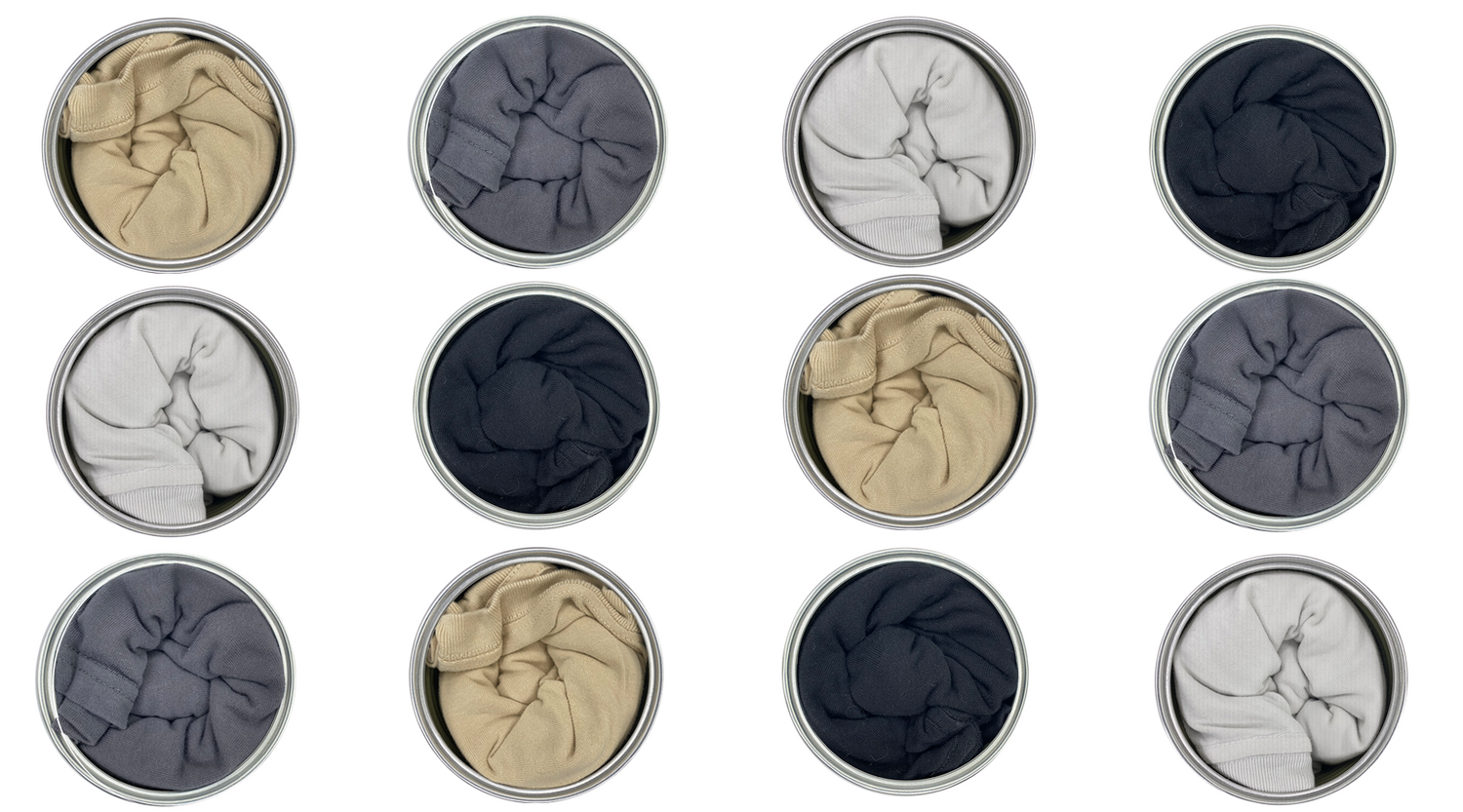
What happens: every activated can funds 50 cents toward a cause the buyer picks. Ocean and river plastic cleanup, tree planting, food support, funding a school day, bee protection, or seagrass planting. Roughly a pound of plastic, or three trees, or five meals, depending what they choose.
The packaging: the can is the packaging, and it's aluminium, which is recyclable indefinitely. There's no polybag. Most people don't recycle it, they keep it, which is arguably better.
Durability: a 210 GSM garment-dyed cotton tee. Heavier than a giveaway blank, and garment-dyed fabric fades evenly instead of going patchy, so it looks better in two years than new.
Customer verification: the card inside has a code. They scan it at cannedgoods.love, choose the cause themselves, and see it land. They're not trusting me, which is the only version of this I think holds up.
Each can also has plantable flower seeds and a sticker in it.
What customers actually ask
Narrower than the marketing assumes, and worth knowing so you can prepare for it.
They rarely ask about supply chains, certifications, or materials science. What they ask, standing at the counter, is some version of "does this actually do anything?" They're asking whether they're being sold a feeling.
A staff member who answers with one concrete sentence closes that. A staff member who reaches for the brand's adjectives does not, and the customer walks away slightly more cynical than they arrived.
Which means the real test of eco stock isn't the product. It's whether the person working Saturday can explain it without guessing. Write the shelf card yourself, one sentence, and don't use the supplier's copy.
How to merchandise it, which is where most shops go wrong
Don't build an eco section.
The moment you section it off, you've told the customer the rest of the shop is the other kind. It also turns a normal purchase into a values decision, which is a slower sale.
What works better is one or two items that pass all four questions, stocked in the normal run of the shop, that your staff can explain in a sentence when somebody asks. The explanation is the product. One defensible item beats a shelf of adjectives, and it's a considerably easier conversation at the till.
More on judging stock in how to tell if a souvenir will sell, on the wider sustainability question in sustainable souvenirs, and the custom process is on the custom cans page.