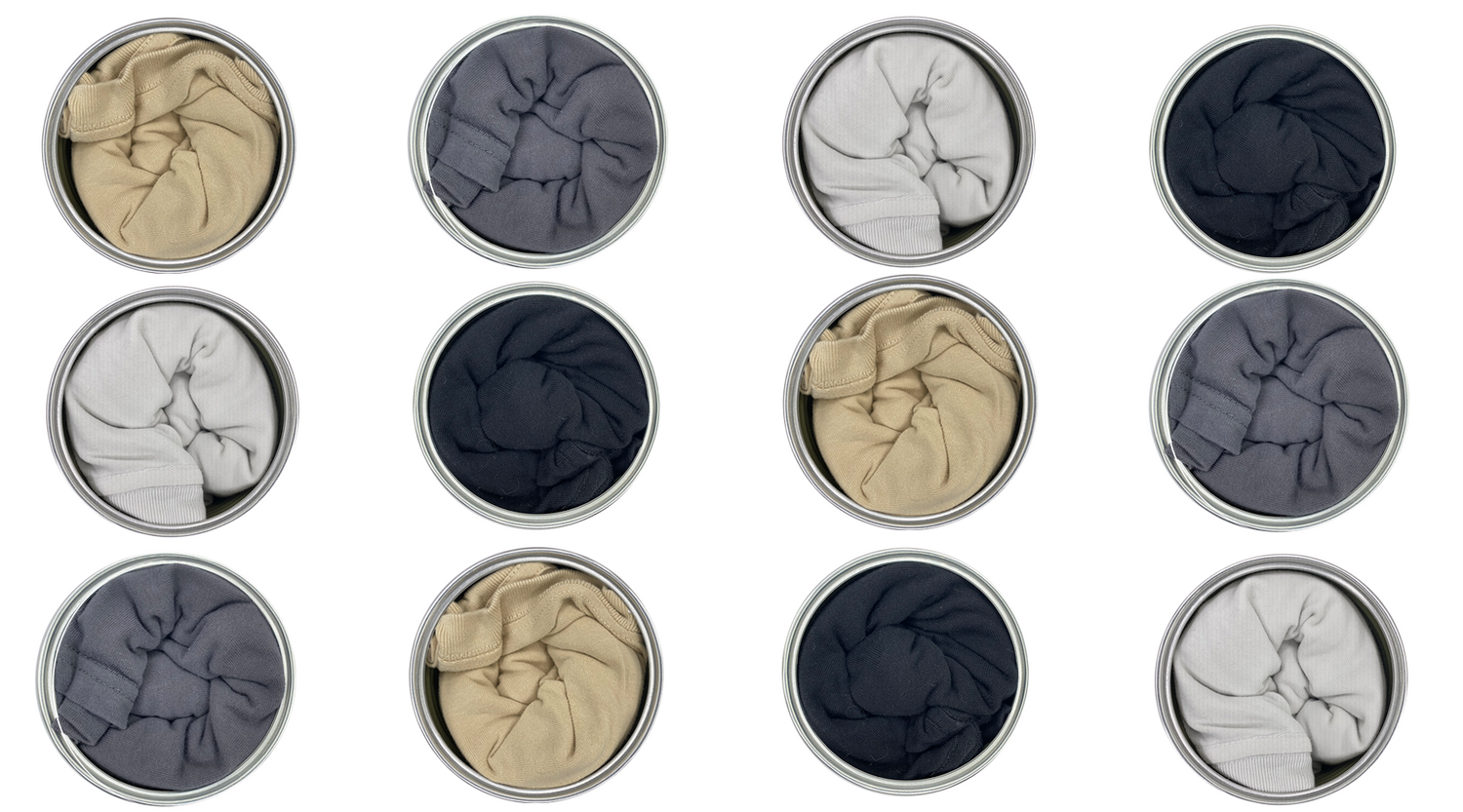

What makes something collectible, and what just makes it clutter
There's a shoebox somewhere in your house you can't throw away. Ticket stubs, a tin from a holiday, a sneaker box you've kept the lid for. No resale value, no use, still there.
I think about that a lot, because it's the difference between a souvenir someone keeps and one that goes in a drawer, and I got it wrong for about a year.
One object is a purchase. A set is a project.
Buy one thing and the transaction closes. You own it, your brain files it, done.
A set doesn't close. If you've got three of seven, the missing four sit in the back of your head as an unfinished job. Psychologists call it the Zeigarnik effect, the tendency to keep returning to incomplete tasks. Anyone who ever had one missing sticker in a football album knows exactly what that feels like without needing the term.
There's a well-documented commercial version. In 2006 Joseph Nunes and Xavier Drèze ran a study at a car wash with loyalty cards. One group got a card needing eight stamps. Another got a ten-stamp card with two already filled in. Both groups needed eight more washes to finish. The group with the head start completed at roughly 34%, against about 19% for the group starting from zero.
The progress was fake. The behaviour change wasn't.
The four kinds of scarcity, and the three that expire
Scarcity works because availability stands in for value. The classic demonstration is Worchel, Lee and Adewole's 1975 study where identical cookies got rated as more desirable when there were two in the jar instead of ten. Nothing about the cookie changed.
But not all scarcity is the same, and most of it has a shelf life.
| Kind | Example | How long it holds |
|---|---|---|
| Time-limited | Seasonal flavour, holiday design | Short. Ends when the season does. |
| Quantity-limited | A run of 500, numbered | Medium. Ends when it sells out, or doesn't. |
| Place-limited | A design that exists in one shop | Long. Can't be dissolved by making more. |
| Artificially withheld | Fake sellouts, drop theatre | Short, and corrosive once spotted. |
Place-limited is the only one that doesn't decay, and it's the one almost nobody uses. It isn't a promise about supply that you might break. It's a fact about geography. A design that only exists in one shop in one town doesn't become common because you printed more units. It stays tied to that address forever.
That's why every shop we work with gets its own artwork rather than a variation on a template. It isn't generosity. It's the only version of scarcity that still works in five years.
Where it stops working
Worth being honest about the failure modes, because they're real.
People smell a fake limit. Restock a sellout once and you've taught everyone the limit was theatre. They won't rush next time.
Scarce but unwanted is still unwanted. Scarcity multiplies demand, it doesn't create it. A limited run of something nobody likes is just a smaller pile of dead stock.
An impossible set kills the impulse. If completing it needs a flight, most people don't start. The set has to feel finishable.
Fuzzy edges stop the whole thing. This is the one brands get wrong most. Collectors need to know what counts. Pokémon cards have set symbols. National park passports have one stamp per site. If someone can't tell what's in the collection, they never start counting, and the entire mechanism fails to switch on.
Collections that already work, and why
Worth looking at what's already out there, because none of this is new and the patterns are consistent.
National park passports. A book, a stamp at each site, free to use. The genius is that the stamp costs nothing and the book costs almost nothing, so the whole value sits in the effort of getting there. People plan holidays around filling it.
Disney pin trading. Thousands of designs, some park-exclusive, some event-exclusive, an active secondary market and a trading culture with its own etiquette. What makes it work is that scarcity is tied to where and when you were, which is unfakeable.
Bottle caps and crown corks. Free, ubiquitous, and collected anyway, because breweries vary them by release and region. Proof that price has almost nothing to do with whether something gets collected.
Trading cards. The most engineered version, and the one that shows the danger. Print too many and the secondary market collapses, which takes the collecting culture with it. Scarcity you control is scarcity you can destroy.
The through-line: the best collections are tied to a place or a moment rather than to a manufacturing decision. You can always print more cards. You can't print more Yellowstone.
The bit I got wrong
For about a year I thought the shirt design was the product and the can was packaging.
That's backwards. The can is what people photograph, keep, line up, and mention to other people. The shirt has to be genuinely good, or the whole thing reads as a gimmick and people feel stupid for buying it, but the shirt isn't why anyone picks it up.
Once I understood that, I stopped pitching shops on fabric weight. Leading with fabric puts me in a competition with every merch supplier in the country on their terms. Leading with the fact that nobody else on their street can sell this exact thing is a conversation nobody else is having with them.
Why place-specific beats generic every time
A generic shirt competes on price and design. A place-specific one doesn't compete at all, because there's no substitute. You can't buy the Sedona one in Denver.
Souvenir buying is mostly about proof and story. The purchase is a receipt for having been somewhere, which is why the town name outsells the better graphic almost every time. People aren't buying an object, they're buying evidence.
That also explains why collections form around places rather than products. Somebody with cans from four towns has a map, not a pile of shirts.
How many is a set
Something I've thought about more than is probably healthy.
Too few and there's no chase. Three of anything isn't a collection, it's three things. Too many and it's hopeless, and hopeless means people don't begin.
The sweet spot seems to be somewhere people can picture finishing without finishing quickly. Enough that it takes real effort and some travel, few enough that it's clearly possible. When it's a town, that number tends to set itself: however many good shops there are is however many cans there are, and that's a naturally sensible size.
Which is another quiet advantage of place-based scarcity. You don't have to pick the number. The place picks it.
What this means if you sell things
Three practical things fall out of it.
Give the set a legible edge. People need to know what's in it. If your collection is vague, nobody counts, and if nobody counts, nobody chases.
Make the object worth keeping. A collectible that goes in a drawer stops working. Display-ability is doing more work than most people credit. Ours is a reusable aluminium can precisely because it sits out where people see it.
Don't fake the scarcity. Use a real constraint. Place is the best one available because you can't accidentally break it.
One more thing about display
A collectible that can't be displayed quietly stops being one.
This sounds obvious and almost nobody designs for it. Fridge magnets work partly because everyone already owns the display surface. Pins work because a jacket or a lanyard does the job. Anything that needs a shelf you don't have is fighting uphill.
It's worth asking of any product: where does this physically live once someone owns four of them? If the honest answer is a drawer, the collection will stall no matter how good the individual object is.
And if you just like the cans
Plenty of people who collect these have no interest in the business side, which is fine and honestly the point.
Every shop that carries ours has its own design, so if you pick one up somewhere, that's the only place it exists. Some people chase that deliberately. Some people just end up with four on a shelf and notice afterwards that they've started something.
Either way, there's a card inside with a code on it. You scan it at cannedgoods.love and pick where 50 cents goes, which means a collection also adds up to something beyond the shelf it's sitting on.
The canned tees collection has whatever's current, what a shirt in a can actually is covers the format, and if you run a shop and want your own, that's the custom cans page.